
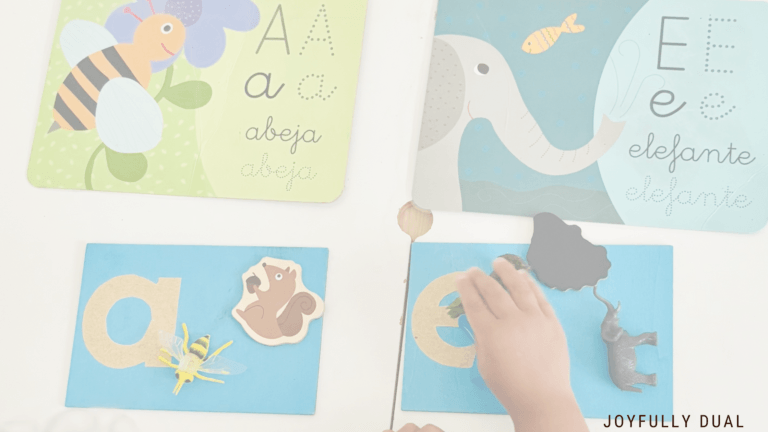
How to Introduce Letters in Spanish Using Montessori Methods
If you’ve been following this series, you know our reading journey didn’t begin with the alphabet.
First, we built a strong foundation of oral language through conversations, books, songs, and everyday experiences. Then we spent months developing phonemic awareness by playing with sounds, rhyming words, and listening carefully to spoken language.
Only after my son was confidently hearing and identifying sounds did we move to the next step: introducing letters in Spanish.
How My Son Learned to Read in Spanish Series
Part 1: Oral Language Foundations
Part 2: Phonemic Awareness in Spanish
Part 3: Introducing Letters in Spanish ← You are here
Part 4: Blending Sounds and First Words
In this blog post you’ll learn:
- How I knew my son was ready to begin learning letters
- Why I introduced letter sounds before letter names
- How Montessori-inspired activities made learning meaningful
- The hands-on materials we used most
- Simple ways to introduce letters in Spanish at home
- Why taking it slow made reading easier later
From Hearing Sounds to Seeing Them
By the time my son was about three years old, I noticed something had changed.
He wasn’t just hearing sounds anymore.
He was playing with them.
He could identify beginning sounds in familiar words, blend simple sounds orally, and sometimes even started our sound games on his own.
That was my signal.
He was ready to connect the sounds he already knew to written symbols.
Instead of rushing into alphabet worksheets or asking him to memorize letters, I chose a Montessori-inspired approach that emphasized exploration, movement, and hands-on learning.
Looking back, I’m so glad we waited until he was ready.
Because when letters finally appeared, they weren’t random shapes to memorize.
They represented sounds he already understood.
What Does It Mean to Introduce Letters in Spanish?
Introducing letters in Spanish means helping children connect the sounds they already know to the written symbols that represent those sounds. Instead of memorizing the alphabet, children learn that every letter represents a sound they have already heard and used in everyday language.
This may seem like a small difference, but for us it changed everything.
Instead of asking my son to memorize abstract symbols, I helped him discover that reading is simply another way of representing spoken language.
That made learning feel meaningful from the very beginning.
Why I Taught Letter Sounds Before Letter Names
One of the biggest decisions I made was to teach letter sounds before letter names.
Most of us grew up singing the alphabet song long before we ever learned to read. While knowing letter names is important, I realized it wasn’t the skill my son needed first.
My goal wasn’t for him to recite the alphabet.
My goal was for him to become a reader.
So whenever I introduced a new letter, I focused on its sound.
Instead of saying,
“This is the letter M.”
I would simply say,
“This says /m/.”
That small shift made a huge difference.
Later, when he began blending sounds together, he wasn’t trying to remember a letter’s name first. He already knew the sound it represented.
Reading became much more natural because he understood what each symbol meant.
Why Spanish Is a Great Language for Beginning Readers
One of the reasons I loved introducing letters in Spanish before English is that Spanish has a much more predictable relationship between letters and sounds.
In Spanish:
- Most letters make one consistent sound.
- Words can usually be read exactly as they are written.
- There are very few irregular spellings.
That consistency helped my son build confidence early.
Instead of guessing how a word might sound, he learned that each letter represented a specific sound he already recognized.
Later, when we introduced English, he already understood the most important concept of reading:
Letters represent sounds.
Even though English has many exceptions, the reading foundation he built in Spanish transferred beautifully.
Our Favorite Montessori Material: Sandpaper Letters
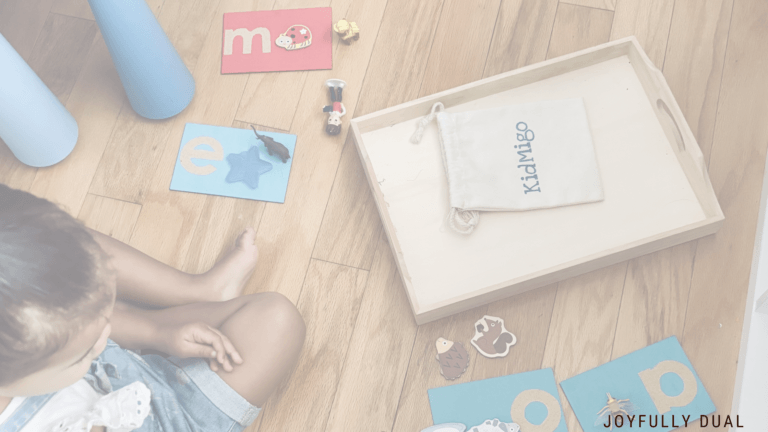
If I had to choose one Montessori material that had the biggest impact on our reading journey, it would be sandpaper letters.
They may look simple, but they engage several senses at once.
As my son traced each letter with two fingers, he was:
- seeing the letter
- hearing its sound
- feeling its shape
- strengthening the muscle memory needed for writing later
That combination of movement, touch, sight, and sound created a much stronger connection than simply looking at a letter on a flashcard.
One afternoon, while we were putting away groceries, my son pointed excitedly to the letter M on a milk carton.
“/m/!” he shouted with the biggest smile.
I hadn’t asked him any questions.
I hadn’t been testing him.
He simply recognized it because we’d spent so much time exploring that sound with our sandpaper letters.
It was one of those small parenting moments that reminded me something important:
Children are often learning long before we realize it.
How We Introduced Letters One Sound at a Time
One mistake I often see is introducing the entire alphabet at once.
We did the opposite.
We focused on just two or three letters per week, choosing sounds my son already recognized from our phonemic awareness games.
That made every new letter feel familiar instead of overwhelming.
Some days we practiced for ten minutes.
Other days we skipped completely.
There was never pressure to finish a lesson or meet a milestone by a certain age.
I wanted curiosity, not a checklist, to guide our learning.
Looking back, I believe that slower pace helped my son build confidence because every new letter felt like a discovery rather than another fact to memorize.
The Montessori Three-Period Lesson
One Montessori strategy that worked beautifully for us was the Three-Period Lesson.
It introduces new concepts gradually while allowing children plenty of opportunities to succeed.
First Period: Naming
I introduced the sound.
“This says /s/.”
“This says /m/.”
There was no pressure to remember anything.
The goal was simply exposure.
Second Period: Recognition
Next, I invited my son to interact with the letters.
“Can you show me /m/?”
“Can you trace /s/?”
This stage helped reinforce learning through movement and repetition.
Third Period: Recall
Only after he seemed confident would I ask,
“What sound is this?”
If he hesitated, we simply returned to the first stage.
There was never a sense of failure.
Only another opportunity to explore together.
Montessori-Inspired Activities for Introducing Letters in Spanish
One of the biggest lessons I learned is that introducing letters in Spanish doesn’t require long lessons or expensive materials.
The most effective activities were simple, hands-on, and easy to weave into our daily routine.
Some of our favorites included:
- Tracing sandpaper letters while saying the letter sound aloud.
- Writing in a salt tray to practice letter formation in a playful, low-pressure way.
- Matching miniature objects to their beginning sounds (like mesa, mano, and mariposa for /m/).
- Going on letter hunts around the house, in books, and on food packaging.
- Air writing, where we traced large letters with our arms while repeating the sound.
None of these activities lasted very long. A few minutes of focused, joyful practice was far more effective than trying to squeeze in a formal lesson.
What I Focused On (and What I Didn't)
At this stage, my goal wasn’t to teach my son to read as quickly as possible.
I wanted him to build confidence by understanding that letters represented the sounds he already knew.
That meant focusing on:
- sound-letter correspondence
- exploration through play
- repetition without pressure
- following his pace
I intentionally avoided rushing through the alphabet, correcting every mistake, or expecting perfect handwriting.
Building a strong foundation mattered more than moving quickly.
Key Takeaway
Introducing letters in Spanish doesn’t have to feel rushed or complicated.
When children first develop strong oral language and phonemic awareness, letters become meaningful instead of something to memorize.
Whether you use Montessori materials or simple items you already have at home, the goal is the same: help your child discover that written letters represent the sounds they already know.
Coming Next in the Series
By this point, my son could hear sounds, recognize letters, and confidently connect the two.
The next step was learning to blend those sounds together to read his first Spanish words.