Blending Sounds in Spanish: How My Child Learned to Read
If you’ve been following this series, you know our reading journey didn’t begin with the alphabet. First, we built a rich foundation of oral language through conversations, songs, books, and everyday experiences. Next, we developed phonemic awareness by helping my son hear, identify, and play with the sounds in spoken words. Then, we introduced letters in Spanish, connecting those familiar sounds to written symbols through Montessori-inspired activities. Now we had reached the exciting part: Blending sounds in Spanish.
This was the moment everything finally came together.
Instead of hearing separate sounds, my son began putting them together to read real words.
Looking back, this was the turning point in our reading journey.
How My Son Learned to Read in Spanish Series
Part 1: Oral Language Foundations
Part 2: Phonemic Awareness in Spanish
Part 3: Introducing Letters with Montessori
Part 4: Blending Sounds and First Words ← You are here
In this blog post you’ll learn:
- What blending sounds is and why it matters
- Why I focused on blending instead of memorizing syllables
- The simple games that helped my son begin reading
- How blending prepared him to read in both Spanish and English
- Why playful learning made all the difference
What Is Blending Sounds in Reading?
Blending sounds is the ability to combine individual letter sounds to read a complete word.
For example:
/s/ + /o/ + /l/ = sol
/p/ + /a/ + /n/ = pan
Instead of memorizing words, children learn how to decode them by putting sounds together.
This is one of the most important early reading skills because it allows children to read unfamiliar words independently.
For us, blending was the bridge between recognizing letters and actually reading.
Why We Practiced Blending Sounds Instead of Memorizing Syllables
Many traditional Spanish reading programs begin with syllables:
- ma
- me
- mi
- mo
- mu
There is absolutely nothing wrong with learning syllables. In fact, they’re an important part of reading Spanish.
But I didn’t want memorization to become the foundation of my son’s reading.
Instead, I wanted him to understand how words work.
Because he already knew individual letter sounds, blending felt like solving a puzzle.
Instead of memorizing ma, he understood that /m/ and /a/ together created ma.
That understanding made reading much more flexible.
It also gave him a foundation that later transferred well to English, where memorizing syllables alone isn’t enough.
Our Favorite Blending Activities in Spanish
We never turned blending into a formal lesson.
Instead, we played.
Those playful moments became some of the most effective reading lessons we ever had.
1. Robot Talk
One of our favorite games was “Robot Talk.”
I would slowly stretch out the sounds in a word:
/s/… /o/… /l/
Then my son would guess the mystery word.
Sometimes we laughed when he guessed something silly.
Sometimes he figured it out immediately.
Either way, he was practicing one of the most important reading skills without realizing it.
2. Stretching Words
Another activity we loved was stretching familiar words.
Instead of saying sol, I exaggerated every sound:
“Ssssssssooooooolllll.”
Then he blended the sounds back together naturally.
This helped him hear that words are made of individual sounds that can be combined again.
3. Mystery Word Game
During playtime I often described an object using segmented sounds.
“I’m thinking of something that says…”
/m/ /e/ /s/ /a/
His face would light up when he guessed,
“¡Mesa!”
These tiny games fit naturally into our day and never felt like school.
4. Build-a-Word
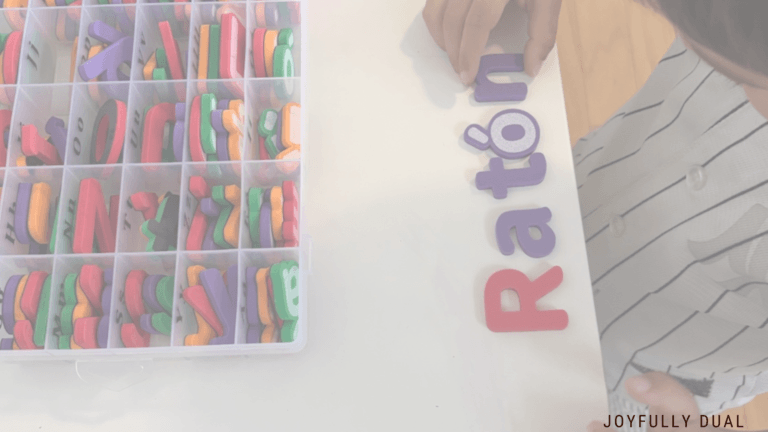
We also used magnetic letters, movable letters, and picture cards.
After identifying each sound, we pushed the letters together while saying the complete word aloud.
Seeing the letters move together helped reinforce that reading isn’t memorizing, it’s blending.
One Moment I'll Never Forget
One afternoon we were reading a simple Spanish book together.
I pointed to the word sol.
Instead of waiting for me to read it, my son quietly whispered,
“/s/… /o/… /l/…”
Then he smiled and proudly said,
“¡Sol!”
I hadn’t taught him to memorize that word.
He figured it out.
It lasted only a few seconds, but I still remember that moment clearly.
That was when I realized all the conversations, sound games, and Montessori activities we’d done over the previous months were finally coming together.
Reading had begun.
Reading Skills Continued to Grow
Once my son became comfortable blending sounds, I noticed something exciting.
Reading was no longer just an activity we did together, it was becoming something he could do on his own.
He started recognizing simple words in books, pointing out familiar words on signs, and sounding out new words with growing confidence.
Of course, he didn’t read every word perfectly.
And I didn’t expect him to.
The goal was never perfection.
The goal was to help him understand how reading works.
As his confidence grew, we naturally continued building other literacy skills like vocabulary, comprehension, rhyming, and early writing. Each new skill strengthened the others.
Reading wasn’t one big milestone.
It was the result of many small moments adding up over time.
Why Blending Sounds Supports Reading in English
One of the questions I often hear is whether learning to read in Spanish first makes reading English more difficult.
Our experience was just the opposite.
By learning blending sounds in Spanish, my son developed a decoding strategy that transferred naturally when he began reading English.
Even though English has many irregular spellings, he already understood one important concept:
Letters represent sounds, and those sounds can be blended together to read words.
The language changed, but the reading process stayed the same.
That strong foundation made learning to read in English feel much less overwhelming.
What Made the Biggest Difference
Looking back, there wasn’t one magic activity or one perfect lesson that taught my son to read.
It was the combination of many small, consistent experiences.
Here are the lessons I’ll carry with me:
We Chose Consistency Over Perfection
Five or ten minutes of playful learning each day had a much greater impact than occasional long lessons.
We Learned Through Play
Games, conversations, books, and everyday moments kept learning enjoyable and meaningful.
We Followed His Pace
I never introduced a new skill until he was ready.
Building a strong foundation made each new step feel natural.
We Made Spanish Part of Everyday Life
Spanish wasn’t just something we practiced during “school time.”
It was the language of our conversations, stories, songs, and family routines.
That constant exposure supported his reading in ways that formal lessons alone never could.
Key Takeaway
Learning blending sounds in Spanish was the moment everything came together for my son.
After months of building oral language, developing phonemic awareness, and introducing letters, he finally understood how individual sounds worked together to create words.
That understanding, not memorization, became the foundation of his reading journey.
Whether you’re teaching your child in Spanish, English, or both, remember that reading grows one small step at a time
Looking Back on Our Reading Journey
When I think about how my son learned to read, I don’t remember worksheets or flashcards.
I remember bedtime stories.
Songs in the car.
Conversations during grocery shopping.
Sound games that made us laugh.
Tracing sandpaper letters at the kitchen table.
Those ordinary moments became the foundation for everything that followed.
Reading didn’t happen overnight.
It happened one conversation…
one sound…
one letter…
and finally, one word at a time.
If there’s one thing I hope you take away from this series, it’s this:
You don’t have to rush.
Children learn best when they feel connected, curious, and supported.
Keep talking.
Keep reading.
Keep singing.
Keep playing.
Those small moments matter more than you realize.
Thank You for Following Our Journey
Thank you for joining me through this four-part series on how my son learned to read in Spanish while growing up in an English-speaking environment.
I hope our family’s experience encourages you to enjoy the process instead of worrying about reaching milestones.
Every child learns differently.
Trust your child.
Trust the process.
And most importantly, enjoy the journey together.
If you found this series helpful, I’d love for you to explore more bilingual parenting and early literacy resources here on Joyfully Dual.